Walk into any jewelry chain and the architecture of the store tells you a story before you look at a single piece. Two sections. Two sets of aesthetics. Two sets of assumptions about who you are and what you should want based on the gender you appear to be. The 'women's' section has the delicate things — the florals, the stones, the fine chains, the small hoops. The 'men's' section has the heavier things — the black metals, the wider bands, the industrial edges, the styles coded as tough or minimal. The implication underneath all of it is that your gender determines your relationship to adornment, which is one of the more historically unsupported ideas that nonetheless refuses to die.
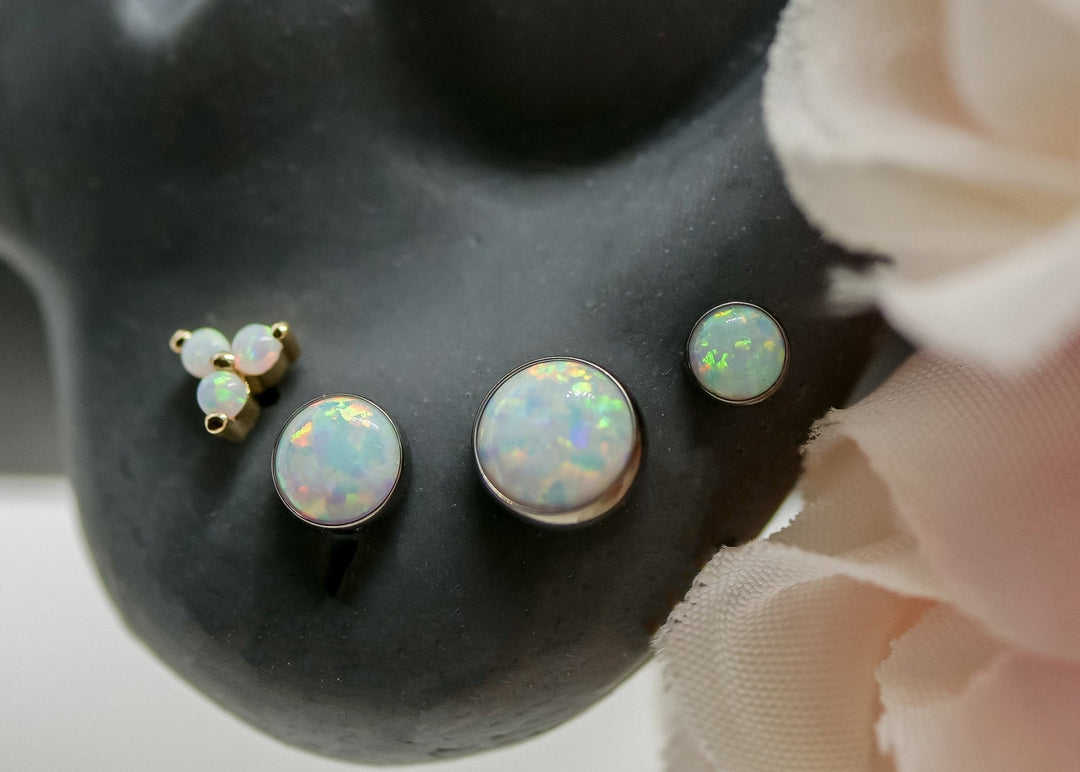
Jewelry doesn't have a gender. The decision to put a 3mm opal cabochon in your conch or a blackened steel seamless ring in your septum is a decision about aesthetics, about your personal visual language, about what looks right on your body and in the context of how you present yourself — not a gender declaration that needs to track with how the world reads you or how you were categorized at birth.
The gendering of jewelry is downstream of the gendering of adornment generally, which is downstream of a long history of using aesthetics to enforce gender conformity. 'Masculine' jewelry is designed to signal that the wearer is not trying too hard, not being precious, not vain — because vanity has been coded as feminine and feminine has been coded as lesser. 'Feminine' jewelry is delicate because delicacy has been assigned to women as an aspirational quality. None of this has anything to do with what metal looks like or what it does on a body. It's all imposed.
At House of GRIM, we don't organize jewelry by gender. We organize it by style, placement, and material. When someone sits down for a consultation, we ask what they're drawn to, what they want the piece to do in the context of their overall look, what they want it to feel like to wear. We don't ask which section they were browsing in at the mall or whether the reference photo they brought is from a 'men's' or 'women's' editorial.
This matters beyond the individual shopping experience. The body modification community has historically been one of the spaces where gender conformity in appearance got actively disrupted — people of all genders, all body types, all expressions, modifying themselves on their own terms, using their bodies as a site for self-determination rather than social compliance. That history is part of why the industry exists in the form it does. It's part of why this studio exists.
Wear what you want. Wear what looks right on your specific body and face and ear and nose. The jewelry doesn't know what gender you are and it doesn't care. Neither do we.